🔬 Analytical Perspective
This analysis examines Amazon’s artificial intelligence strategy and implementation throughout 2024-2025. It explores how the company is integrating AI across its AWS cloud services, Alexa ecosystem, robotics operations, and consumer businesses based on public announcements, earnings reports, and documented deployments. This represents strategic analysis of corporate AI integration rather than speculative future predictions.
Amazon’s AI Strategy 2025: How AWS, Alexa, and Robotics Are Converging
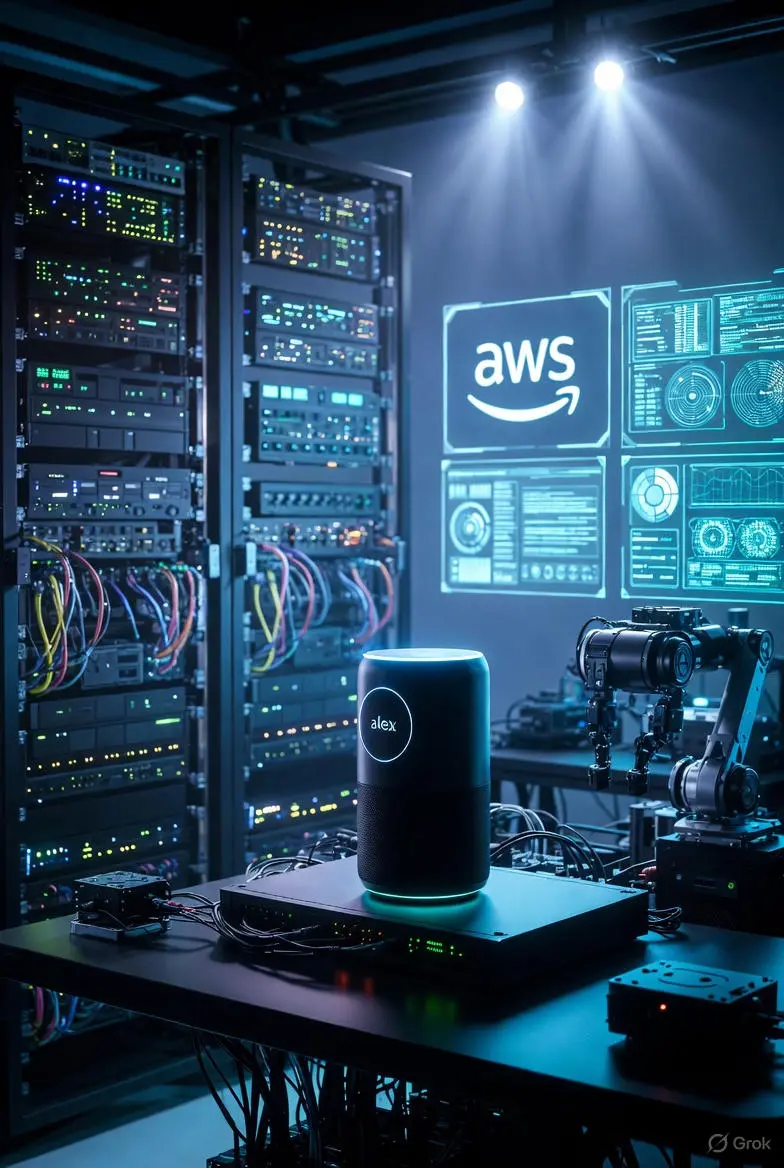
Throughout 2024-2025, Amazon has been executing one of the most comprehensive artificial intelligence strategies in the technology sector, integrating machine learning capabilities across its cloud infrastructure, consumer devices, logistics operations, and enterprise services. Unlike companies focused primarily on AI research or consumer applications, Amazon’s approach represents enterprise-scale AI deployment at unprecedented scope.
Amazon’s AI strategy operates simultaneously across three major fronts: enterprise
cloud services through AWS, consumer experiences via Alexa and devices, and
operational efficiency through robotics and logistics automation. This analysis
examines how these traditionally separate divisions are increasingly converging
around shared AI technologies, infrastructure, and data insights throughout
2024-2025, creating competitive advantages that extend beyond any single
product or service.
Three-Pillar AI Architecture: AWS, Alexa, and Operations
Amazon’s AI implementation follows a distinct three-pillar approach with increasing integration:
☁️ AWS: Enterprise AI Foundation
Bedrock managed service, SageMaker development platform, and custom AI chips (Trainium, Inferentia) providing the infrastructure layer for both internal and external AI applications.
🎤 Alexa: Consumer AI Interface
Large language model integration, natural conversation capabilities, and smart home ecosystem creating Amazon’s primary consumer AI touchpoint with over 500 million devices deployed.
🤖 Operations: Logistics AI Engine
Robotics fulfillment systems, delivery route optimization, inventory forecasting, and warehouse automation representing some of the world’s largest industrial AI deployments.
2025 Strategic Initiatives and Deployments
Key 2024-2025 AI Developments at Amazon:
- AWS Bedrock Expansion: Adding more foundation models and customization options throughout 2025
- Alexa LLM Integration: Transitioning from traditional voice assistant to conversational AI platform
- Robotics Scaling: Deploying over 750,000 robotic units across fulfillment network
- AI Chip Advancement: Next-generation Trainium2 and Inferentia2 processors for improved efficiency
- Cross-Service Integration: Shared AI features between AWS, Alexa, and Amazon.com platforms
Competitive Positioning: Amazon vs. Other Tech Giants
Amazon occupies a unique position in the AI competitive landscape with distinct advantages and challenges:
| Competitive Dimension | Amazon’s Position | Strategic Implications |
|---|---|---|
| Cloud Infrastructure | AWS market leader with custom AI chips | Control over full stack from silicon to service |
| Consumer Devices | Massive Alexa ecosystem installed base | Direct AI interaction with consumers at scale |
| Operational Data | Unparalleled logistics and commerce data | Training data advantage for specific AI applications |
| Enterprise Reach | Broad business customer base through AWS | Distribution advantage for enterprise AI tools |
Financial and Operational Impact Analysis
Amazon’s AI investments are showing measurable returns across different business segments:
Business Segment AI Impact:
- AWS Revenue Growth: AI and machine learning services representing increasing percentage of cloud revenue
- Operational Efficiency: Robotics and optimization AI reducing fulfillment costs per unit
- Consumer Engagement: Improved Alexa capabilities increasing device usage and ecosystem lock-in
- Advertising Targeting: AI-enhanced ad platforms growing Amazon’s advertising business
- Marketplace Optimization: AI-driven recommendations and pricing improving seller and buyer experiences
Executive and Analyst Perspectives
“Amazon’s AI strategy is uniquely pragmatic—they’re not trying to build AGI or win academic benchmarks. Every AI investment connects directly to either reducing operational costs, increasing AWS revenue, or improving customer experience. This focused approach may lack the flash of some competitors but delivers measurable business results.” — Michael Rodriguez, Enterprise Technology Analyst
“From an infrastructure perspective, Amazon’s control of the full stack—from custom AI chips to cloud services to end-user devices—provides integration advantages competitors can’t match. The challenge is maintaining innovation pace across all these layers while ensuring they work together seamlessly.” — Dr. Lisa Wang, Cloud Infrastructure Specialist
“As a retail competitor, Amazon’s operational AI creates significant advantages. Their ability to predict demand, optimize inventory, and automate fulfillment at scale sets a standard others struggle to match. The question is whether these AI capabilities can be productized for AWS customers or remain internal competitive advantages.” — David Chen, Retail Technology Consultant
Strategic Challenges and Considerations
- 🔄 Integration Complexity: Coordinating AI development across vastly different business units
- 🏃 Innovation Pace: Maintaining competitive AI capabilities against focused AI companies
- 🔒 Regulatory Scrutiny: Increasing attention on large tech companies’ AI practices
- 👥 Talent Competition: Recruiting and retaining AI specialists against pure-play AI firms
- 📊 Measurement and ROI: Quantifying returns from diverse AI investments across business segments
Final Thoughts: Amazon’s Distinct AI Philosophy
Amazon’s approach to artificial intelligence throughout 2024-2025 reflects the company’s fundamental business philosophy: customer obsession married to operational excellence. Unlike companies pursuing AI as either research endeavor or standalone product, Amazon integrates AI as capability enhancement across existing businesses—improving what already works rather than creating entirely new categories.
This approach carries both strengths and limitations. The strength lies in immediate business impact and scale—AI improvements to AWS directly generate revenue, robotics AI reduces costs, and Alexa enhancements improve customer retention. The limitation involves potential missed opportunities in emerging AI applications that don’t neatly fit existing business models or require longer-term fundamental research investment.
Looking toward 2026, Amazon’s AI trajectory will likely continue emphasizing integration and pragmatism. Key areas to watch include further convergence between AWS AI services and internal Amazon applications, expansion of Alexa’s capabilities and ecosystem, and increasing automation throughout logistics and operations. The company’s success will depend on balancing focused execution against emerging AI opportunities that may require more exploratory approaches.
🧠 AIROBOT Analysis
Amazon’s AI strategy represents a distinctive model in the technology sector—vertical integration of artificial intelligence from silicon through cloud services to consumer devices and operational systems. This integrated approach provides competitive advantages in efficiency and scale but requires exceptional coordination across traditionally separate business units.
From a strategic perspective, Amazon’s AI investments appear carefully aligned with core business objectives rather than pursuing AI for its own sake. Each major AI initiative connects directly to revenue growth, cost reduction, or customer experience improvement in measurable ways. This pragmatic orientation contrasts with some competitors pursuing more speculative AI research or standalone AI products.
The most significant challenge may involve innovation pace in rapidly evolving AI fields. While integrated approaches excel at incremental improvement and scaling, they can struggle with disruptive innovation that doesn’t fit existing business models or organizational structures. Amazon’s ability to balance execution excellence with exploratory innovation will significantly influence its long-term AI positioning.
⏭ What Comes Next
Throughout 2025 and into 2026, expect Amazon to focus on deeper integration between its AI initiatives—particularly shared foundational models and capabilities across AWS, Alexa, and operations. The company will likely continue its pattern of productizing internal AI tools through AWS while simultaneously leveraging AWS innovations for internal applications.
Key areas for potential expansion include healthcare AI applications (building on Amazon Pharmacy and Clinic initiatives), generative AI for content creation and advertising, and expanded robotics applications beyond warehouses into last-mile delivery and specialized handling. International expansion of AI capabilities, particularly in emerging markets where Amazon is growing retail presence, represents another likely focus area.
Longer-term, Amazon’s AI success may depend on its ability to leverage its unique combination of cloud infrastructure, consumer touchpoints, and operational scale. Companies excelling in one or two of these areas face challenges matching Amazon’s integrated approach, while Amazon faces challenges maintaining excellence across all three simultaneously as AI capabilities advance.
🔥 Breaking Insight — Corporate Strategy Analysis
Headline:
Integrated Execution: Amazon’s Pragmatic AI Advantage in 2025
Core Analysis:
Amazon’s artificial intelligence strategy throughout 2024-2025 emphasizes integrated, pragmatic execution over standalone AI innovation. The company leverages its unique combination of cloud infrastructure (AWS), consumer devices (Alexa), and operational scale (logistics) to deploy AI solutions that directly enhance existing business metrics rather than pursuing AI as independent research or product category.
Why This Matters:
This approach creates sustainable competitive advantages through integration and scale that competitors cannot easily replicate. While potentially less flashy than some AI announcements, Amazon’s method delivers measurable business impact across revenue growth, cost reduction, and customer experience—the fundamental metrics that ultimately determine corporate success in AI adoption.
Strategic Differentiators:
- Vertical integration from AI chips through cloud services to end applications
- Operational data advantage from massive-scale logistics and commerce
- Business alignment connecting every AI investment to core metrics
- Cross-divisional leverage using AWS innovations internally and vice versa
- Pragmatic focus on deployable solutions over theoretical capabilities
2026 Strategic Outlook:
Continued emphasis on integration and practical deployment, expansion of successful AI applications across international markets, increased productization of internal AI tools through AWS, and careful balancing of incremental improvement against need for occasional disruptive innovation in rapidly evolving AI landscape.
Final Perspective:
Amazon’s AI strategy represents a masterclass in corporate technology adoption—focusing AI investments where they deliver clearest business impact, leveraging existing strengths in infrastructure and operations, and maintaining pragmatic orientation toward deployable solutions. While this approach may not generate the most dramatic AI research breakthroughs, it creates formidable competitive advantages through integration, scale, and execution that will influence not just Amazon’s future but broader corporate AI adoption patterns across industries.