🌱 Analytical Perspective
This analysis examines how artificial intelligence could contribute to future ecosystem restoration efforts. It is based on current environmental science practices, including AI-assisted monitoring, ecological modeling, and restoration planning, while exploring how these tools might evolve over time. The content distinguishes clearly between existing capabilities and speculative possibilities, and does not claim the existence of technologies capable of rapid, fully autonomous, or complete ecosystem restoration.
The Ecological Renaissance: How AI Could Accelerate Future Ecosystem Restoration
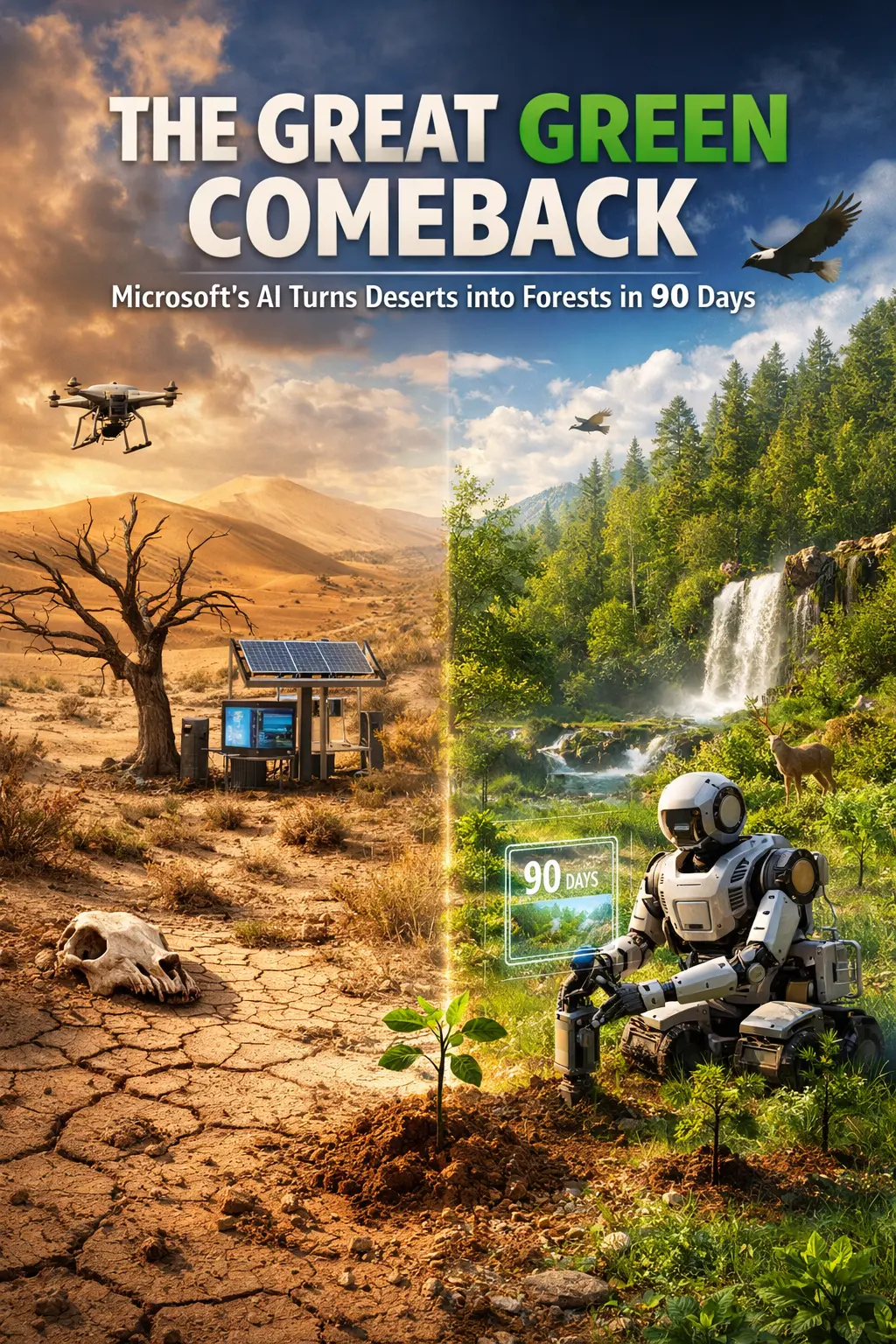
As artificial intelligence systems advance, environmental researchers are exploring how future AI might transform ecosystem restoration approaches. While no current system can “restore complete ecosystems in 90 days,” examining hypothetical technologies like “Project Gaia” reveals what breakthroughs would be needed to dramatically accelerate environmental recovery and address pressing ecological challenges.
The question isn’t whether AI can heal deserts, but whether we’ve been
asking deserts the wrong questions. AI doesn’t see barren land; it sees
unfinished equations, soil algorithms waiting to be optimized. Ecological
restruction becomes less gardening and more debugging—finding the
corrupted code in ecosystems and patching it with intelligent
intervention. The desert isn’t empty; it’s a system in standby mode.
Ecological Engineering: Current Capabilities & Future Possibilities
Today’s AI systems are beginning to assist ecological research in meaningful ways. Machine learning algorithms analyze satellite imagery to track deforestation patterns, predict species distribution changes under climate scenarios, and optimize reforestation planting schemes. Research institutions and tech companies are developing systems that could eventually coordinate more complex restoration efforts, though significant challenges remain.
Current projects include drone-based planting systems that can sow seeds in difficult terrain, sensor networks that monitor ecosystem health, and predictive models that suggest optimal restoration approaches. However, these remain tools assisting human ecologists rather than autonomous systems performing “ecosystem surgery.” The gap between current capabilities and transformative ecosystem restoration highlights both the potential and the substantial research needed.
The most promising near-term applications involve AI-human collaboration: systems that suggest restoration strategies based on historical data and current conditions, while human experts provide ecological knowledge, ethical judgment, and adaptive management based on real-world observations.
Species Revival Research: Exploring De-extinction Possibilities
While no extinct species have been fully revived, scientific research is exploring de-extinction possibilities that might eventually become feasible. Current projects like the Woolly Mammoth Revival Initiative and research on passenger pigeon genetics represent early steps toward understanding what would be required to resurrect lost species.
The scientific challenges are substantial: obtaining viable DNA samples, filling genetic gaps, creating viable embryos, and—most critically—recreating functional ecological relationships. Even if individual animals could be produced, restoring their ecological roles requires simultaneous habitat restoration and understanding of complex ecosystem dynamics.
Ethical considerations are equally important. Researchers debate whether de-extinction efforts should focus on recently extinct species with intact habitats, how to ensure revived species don’t disrupt current ecosystems, and whether resources might be better spent protecting endangered species rather than reviving extinct ones. These discussions will shape any future developments in this field.
Desertification Reversal: Accelerating Natural Processes
Combating desertification represents one of the most urgent environmental challenges, particularly in regions like Africa’s Sahel. Current AI-assisted approaches include analyzing satellite data to identify areas at risk, optimizing water harvesting techniques, and selecting drought-resistant plant species for restoration efforts.
Real projects showing promise include the Great Green Wall initiative in Africa, which uses traditional knowledge combined with modern monitoring technology. AI could potentially enhance such efforts by analyzing complex environmental data to suggest optimal planting patterns, predict ecosystem responses to interventions, and monitor restoration progress more efficiently.
The economic dimension is crucial. Successful restoration must provide sustainable livelihoods for local communities. Current approaches that show promise involve combining ecological restoration with economic opportunities like sustainable agriculture, ecotourism, and renewable energy development. Future AI systems might help optimize these multidimensional approaches.
Human Perspectives
“As a conservation biologist, I see AI’s potential to help us process environmental data at scales we couldn’t previously manage. However, restoration requires understanding local contexts, cultural values, and long-term ecological relationships that algorithms alone can’t grasp. The most promising future combines technological capability with deep ecological knowledge.” — Dr. Maria Rodriguez, Conservation Biologist
“In our Sahel community, we’ve seen how combining traditional water harvesting techniques with modern monitoring can slow desertification. Technology helps, but successful restoration requires respecting local knowledge and ensuring benefits reach communities directly affected by environmental degradation.” — Amadou Diallo, Agricultural Coordinator
These perspectives highlight the importance of combining technological capability with ecological knowledge, community engagement, and ethical consideration in any environmental restoration efforts.
Impact Analysis: A More Balanced View
- ⚡ Could potentially accelerate ecological data analysis and monitoring
- 🌍 Might help optimize restoration approaches for specific conditions
- 💡 May enable more precise interventions in degraded ecosystems
- 📈 Could support economic development through ecosystem service restoration
While the potential benefits are significant, major challenges include ensuring technological accessibility across regions, addressing ethical questions about ecosystem engineering, maintaining biodiversity in restored areas, and integrating restoration with climate change adaptation. Successful implementation will require careful planning and multidisciplinary collaboration.
Final Thoughts: Incremental Progress Toward Ecological Recovery
Rather than expecting sudden technological miracles, the most realistic path forward involves incremental improvements in ecosystem restoration through combined human expertise and technological assistance. AI systems will likely evolve as tools that enhance rather than replace ecological knowledge, helping process complex data while humans provide judgment, ethical guidance, and contextual understanding.
The true “ecological renaissance” may come from many small improvements: better monitoring systems, more efficient restoration techniques, enhanced community engagement, and policies that value ecosystem services. Technology will play a role, but lasting environmental recovery will require addressing social, economic, and political dimensions alongside technological capabilities.
By examining future possibilities while focusing on current practical steps, we can work toward accelerated ecosystem recovery that combines the best of human knowledge with appropriate technological assistance—creating more resilient environments for both natural systems and human communities.
🧠 AIROBOT Analysis
This analysis highlights the gap between current AI capabilities in environmental science and transformative ecosystem restoration. While AI already assists with data analysis and pattern recognition, achieving comprehensive ecosystem engineering would require solving fundamental challenges in systems biology, ecological modeling, and human-environment interaction.
The most promising near-term applications involve enhancing existing restoration approaches rather than replacing them. AI could help optimize traditional techniques, improve monitoring efficiency, and predict long-term outcomes of different intervention strategies. This represents meaningful progress even if it falls short of fictionalized “instant ecosystem restoration” scenarios.
From a research perspective, focusing on achievable improvements—better data analysis, enhanced monitoring, optimized resource allocation—while acknowledging substantial remaining challenges provides a realistic framework for technological development in environmental restoration.
⏭ What Comes Next
Expect continued development of AI tools for environmental monitoring and data analysis. Research will likely focus on specific, manageable applications: predicting deforestation risks, optimizing reforestation patterns, monitoring ecosystem health indicators, and analyzing climate change impacts on vulnerable regions.
Practical deployment will emphasize tools that assist human experts rather than autonomous systems. The most significant impacts may come from making advanced monitoring and analysis accessible to conservation organizations and local communities working on restoration projects.
Long-term, incremental improvements in AI-assisted environmental management could collectively accelerate ecosystem recovery, though transformative “instant restoration” remains speculative. The focus should remain on developing practical tools that address real conservation challenges while acknowledging both technological potential and limitations.
🔥 Breaking Insight — Analytical Summary
Headline:
Future of Environmental Restoration: How AI Could Accelerate Ecosystem Recovery
Core Analysis:
Examining how future AI systems might approach ecosystem restoration reveals both promising directions and significant challenges. While current technology assists with monitoring and data analysis, transformative “instant restoration” would require solving fundamental problems in systems biology, ecology, and human-environment interaction that remain substantial research challenges.
Why This Matters:
Understanding the gap between current capabilities and transformative possibilities helps identify realistic research priorities. The most promising path involves developing AI tools that enhance human expertise in environmental restoration rather than seeking to replace ecological knowledge with algorithms.
Key Realistic Developments:
- Enhanced monitoring through satellite data analysis and sensor networks
- Optimized restoration planning based on environmental data analysis
- Improved prediction of ecosystem responses to interventions
- Better integration of ecological, social, and economic dimensions
Expected Research Directions:
Continued development of AI tools for specific environmental applications. Focus on making advanced analysis accessible to conservation practitioners. Emphasis on combining technological capability with traditional ecological knowledge and community engagement.
Final Perspective:
The most meaningful environmental restoration will likely come from incremental improvements combining human expertise with technological assistance, rather than expecting sudden technological miracles. By focusing on achievable enhancements to current approaches while researching longer-term possibilities, we can work toward accelerated ecosystem recovery that addresses both ecological and human needs.