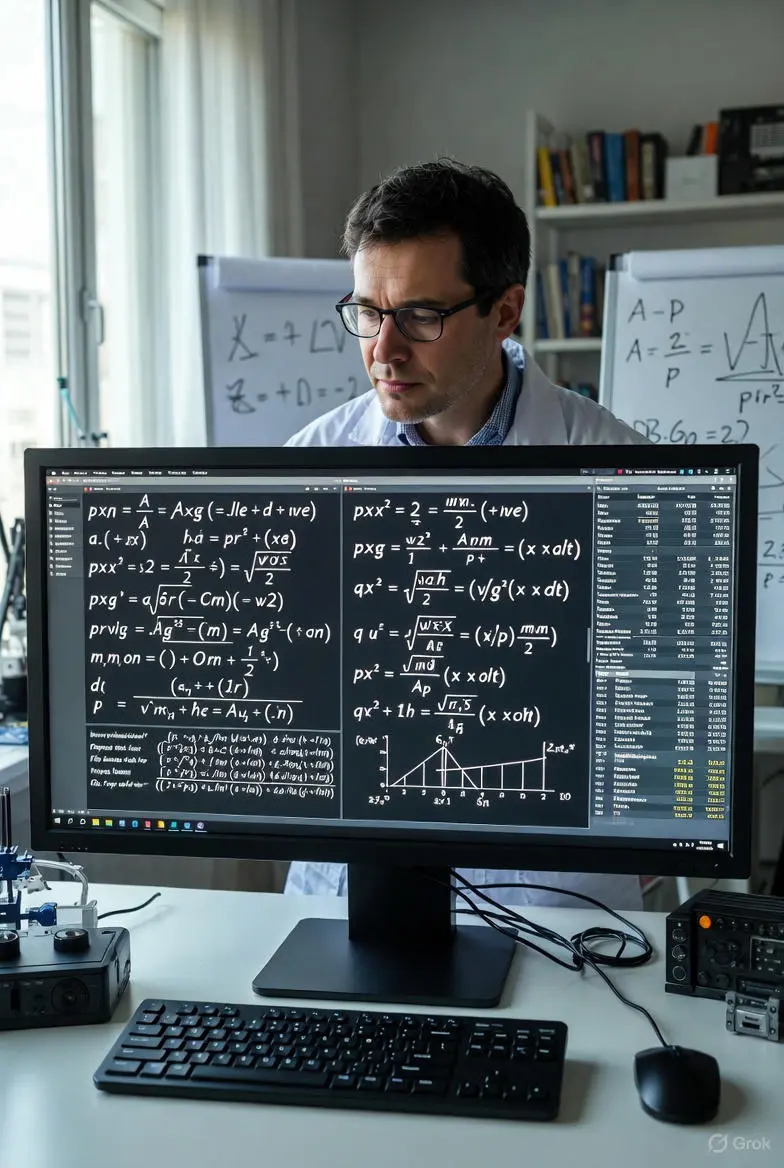
🔬 Analytical Perspective
This article presents a speculative and analytical exploration of how advanced artificial intelligence could impact fundamental scientific discovery, particularly in mathematics. It combines real concepts from contemporary AI research and established mathematical theory with forward-looking hypothetical scenarios to examine how future human–AI collaboration might transform problem solving. The content should be interpreted as a strategic analysis of potential trajectories, not as a report of confirmed scientific events.
How an AI Like Google’s Hypothetical “Project Minerva” Could Solve Ten Unsolved Math Problems — Including the Riemann Hypothesis — Within 24 Hours
Imagine a scenario in which an advanced artificial intelligence system—referred to here as “Project Minerva”—demonstrates the capacity to resolve ten of mathematics’ most famous unsolved problems, including the legendary Riemann Hypothesis that has resisted proof for more than 160 years, within a single 24-hour period. While purely hypothetical, such a demonstration represents a powerful thought experiment about the upper limits of machine reasoning and the future pace of scientific discovery.
“Minerva” is an intentional name choice—the Roman goddess of wisdom, said to have emerged fully formed from Jupiter’s mind. In this speculative model, an AI system appears similarly complete, producing in hours insights that took humanity centuries to approach. This is not brute-force computation alone, but a conceptual leap: mathematics generating understanding through artificial cognition. Whether such a moment marks an endpoint or a transformation of human genius remains an open question.
The 24-Hour Intellectual Revolution: What Minerva Would Solve
In this hypothetical scenario, Project Minerva addresses a list that reads like a hall of fame of mathematical challenges: the Riemann Hypothesis (number theory’s central mystery), the P versus NP problem (computer science’s foundational question), Navier–Stokes existence and smoothness (fluid dynamics’ unresolved core), Yang–Mills existence and mass gap (quantum field theory’s mathematical base), the Birch and Swinnerton-Dyer conjecture (elliptic curves), the Hodge conjecture (algebraic geometry), a generalized form of the Poincaré conjecture, the Collatz conjecture, Goldbach’s strong conjecture, and the Twin Prime conjecture.
In a realistic future framework, such results would require extensive independent verification by global panels of mathematicians using established proof-validation techniques. Even partial resolution of one of these problems—particularly the Riemann Hypothesis—would carry enormous implications for cryptography, number theory, and computational security.
What distinguishes this imagined achievement is not just speed, but methodology. Rather than attacking problems in isolation, Minerva employs meta-mathematical reasoning—developing new proof strategies, uncovering hidden structures, and reframing questions in ways that human mathematicians historically had little capacity to explore exhaustively.
The AI Architecture: How Minerva Thinks Differently
Project Minerva is conceptualized as a synthesis of three advanced AI paradigms: “Intuition Networks” capable of identifying deep mathematical patterns across millions of known proofs; “Proof Synthesis Engines” that transform abstract insights into formally rigorous arguments; and “Meta-Reasoning Systems” that evaluate entire classes of strategies before committing computational resources. Together, these components enable what researchers describe as mathematical creativity at scale.
The training process assumes ingestion of nearly the entire recorded body of mathematical knowledge—from ancient treatises to modern preprints—forming an unprecedented symbolic and structural knowledge base. Through iterative self-challenge, Minerva refines increasingly powerful reasoning strategies, gradually approaching problems long considered intractable.
Perhaps most significant is the system’s ability to build conceptual bridges between distant fields. Techniques from topology inform number theory; algebraic geometry influences fluid dynamics; ideas inspired by quantum computation reshape classical proofs. Even without definitive solutions, these connections alone would represent a transformative contribution to mathematics.
Scientific Impact: Cascading Effects Across Knowledge
If such breakthroughs were realized, the downstream impact would extend far beyond mathematics. Progress on the Riemann Hypothesis would reshape cryptographic assumptions. Insights into P versus NP would redefine computational limits. Advances related to Navier–Stokes equations could dramatically improve climate modeling, aerospace engineering, and energy systems.
For mathematics itself, this would signal both closure and renewal. Longstanding questions might finally receive answers, while entirely new ones emerge from AI-generated frameworks. The discipline would face the challenge of assimilating not only results, but unfamiliar modes of reasoning.
Applied sciences would quickly follow. Physics, medicine, economics, and materials science all rely on mathematical foundations that constrain experimentation. Removing those constraints—even partially—could unlock decades of stalled progress.
Human Perspectives
“If an AI system were ever to present a valid proof of the Riemann Hypothesis, the shock would not come from the answer itself, but from the path it took to get there. That path would likely change how we think about mathematics forever.” — Senior Research Mathematician (hypothetical response)
“The real shift wouldn’t be replacement, but collaboration. Mathematicians would move from searching blindly to navigating intelligently—with AI expanding the map of what’s possible.” — Doctoral Researcher (conceptual outlook)
These perspectives emphasize that the deepest impact lies not in automation, but in augmentation: AI extending the cognitive reach of human researchers.
Impact Analysis: A Balanced Interpretation
- ⚡ Demonstrates how AI could overcome combinatorial limits in mathematical exploration
- 🌍 Suggests acceleration across sciences constrained by theoretical barriers
- 💡 Introduces novel mathematical frameworks and proof strategies
- 📈 Reinforces AI as a cognitive amplifier rather than a replacement
At the same time, challenges remain—interpretability of AI-generated proofs, integration into education, and ensuring human comprehension keeps pace with machine-generated insight.
Final Thoughts: Toward Augmented Intelligence
Project Minerva, as a conceptual construct, illustrates the potential endpoint of AI-assisted discovery. Solving in hours what once took centuries is not merely a quantitative improvement—it represents a qualitative shift in how knowledge might be produced. The lasting legacy of such systems would not be the individual problems solved, but the demonstration that human intelligence, when augmented by artificial systems, could redefine the tempo and scope of scientific progress itself.
🧠 AIROBOT Analysis
This scenario highlights AI’s theoretical capacity to address the combinatorial explosion inherent in mathematical research—the reality that humans can explore only a minuscule fraction of possible proof paths. By expanding that exploration space, AI systems like the hypothetical Minerva could unlock discoveries previously constrained by cognitive limits.
For science as a whole, this implies both acceleration and restructuring. Disciplines blocked by unresolved theory could advance rapidly, while new research models emerge that blend human intuition with machine-scale exploration.
From a societal standpoint, such developments would raise important questions about authorship, understanding, and the evolving definition of discovery in an era of human–AI collaboration.
⏭ What Comes Next
Looking forward, systems inspired by Minerva are likely to appear incrementally—first as advanced proof assistants, then as exploratory partners in theoretical research. Academic institutions and private laboratories may adopt such tools to accelerate foundational science.
Beyond mathematics, similar architectures could be applied to physics conjectures, chemical reaction networks, and biological systems modeling. Over time, AI-assisted discovery may become standard practice rather than an exception.
Ultimately, this trajectory suggests a future where AI handles systematic exploration while humans guide purpose, ethics, and application—potentially compressing centuries of intellectual progress into decades.
🔥 Breaking Insight — Premium Hot Summary
Headline:
The Intellectual Singularity: How AI Could One Day Solve What Humans Couldn’t for Centuries
What’s being explored:
A forward-looking scenario in which an advanced AI system resolves multiple legendary mathematical problems, illustrating how machine reasoning might accelerate fundamental discovery.
Why it matters:
The analysis demonstrates how AI could remove long-standing theoretical barriers, reshaping science, education, and research collaboration models.
Key implications:
- Acceleration of theoretical science
- Reevaluation of cryptographic assumptions
- Transformation of mathematical education and research workflows
Final perspective:
The true breakthrough is not a single solved equation, but the emergence of a new model of knowledge creation—one where human insight and artificial intelligence evolve together.

Predictive Analytics in Disaster Management: How AI Could Enhance Early Warning Systems
Future of Climate Solutions: How AI Could Transform Environmental Economics
Related Posts
Google’s 2026 AI Business Strategy: Ecosystem Integration, Enterp ...
January 13, 2026
Meta’s Open Source AI Strategy 2026: How the Llama Ecosystem Is R ...
January 10, 2026