🔬 Analytical Perspective
This analysis examines NVIDIA’s strategic evolution throughout 2024-2025 as it transitions from GPU manufacturer to full-stack AI computing platform. It explores how the company is leveraging its hardware dominance to build software ecosystems, enterprise solutions, and next-generation computing infrastructure based on public financial reports, product launches, and documented market deployments. This represents corporate strategy analysis in the semiconductor and AI sector rather than speculative investment advice.
NVIDIA 2025: Beyond GPUs – Building the Full-Stack AI Empire
Throughout 2024-2025, NVIDIA has executed one of the most remarkable transformations in technology corporate history, evolving from a graphics processor company to the foundational infrastructure provider for the artificial intelligence era. With data center revenue now constituting over 80% of its business, NVIDIA’s strategic positioning extends far beyond semiconductor manufacturing into software platforms, cloud services, robotics, and enterprise AI solutions.
NVIDIA’s 2025 strategy represents a masterclass in platform ecosystem development—
leveraging GPU architecture dominance to establish software moats, then expanding
into vertically integrated solutions across cloud, edge, and specialized computing.
This analysis examines how the company is systematically constructing barriers to
entry that extend far beyond semiconductor manufacturing, creating what may become
the most defensible position in the history of computing infrastructure.
Three-Pillar Platform Strategy: Hardware, Software, Solutions
NVIDIA’s current market dominance rests on a deliberately constructed three-pillar architecture with increasing vertical integration:
🏗️ Hardware Foundation
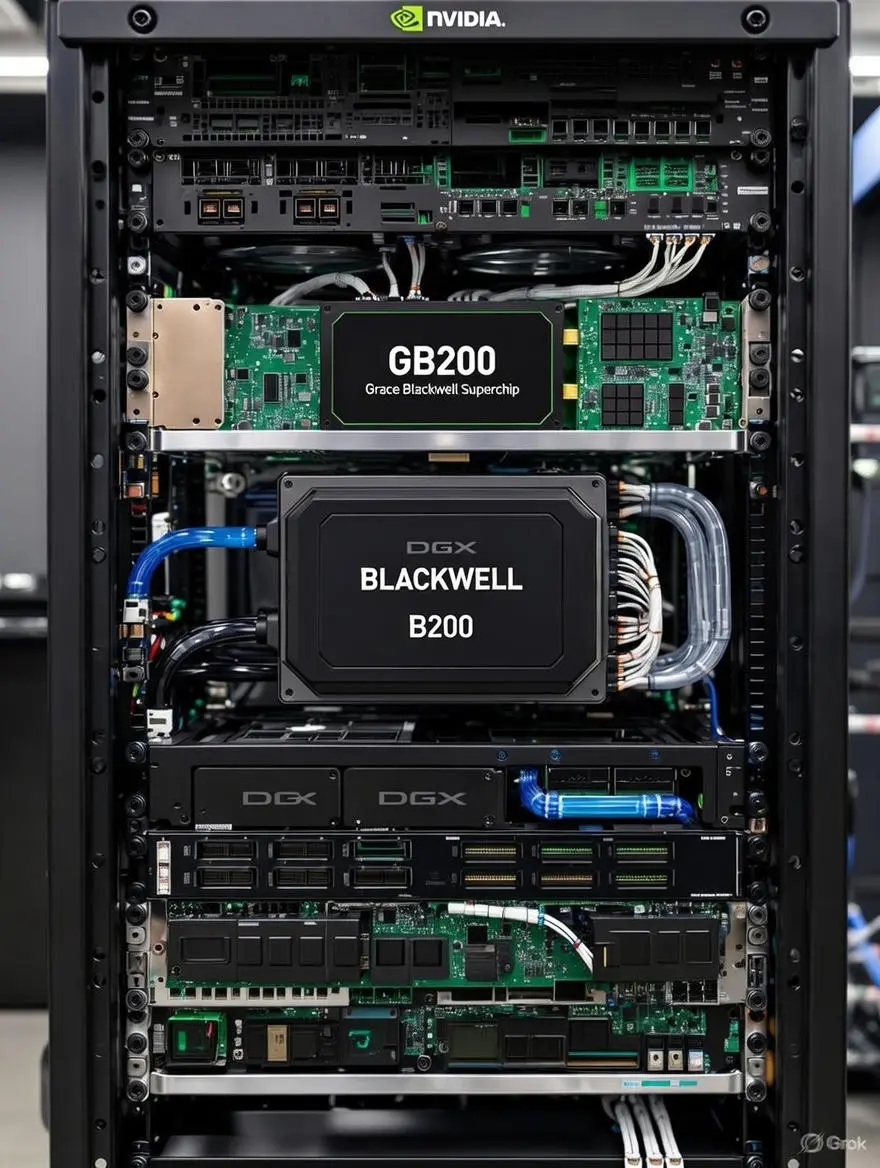
Hopper and Blackwell architecture GPUs, Grace CPU superchips, Spectrum networking, and custom AI accelerators providing unmatched performance per watt for AI training and inference workloads across data centers.
💻 Software Ecosystem
CUDA platform with 4+ million developers, AI Enterprise suite, Omniverse for 3D simulation, and NIM inference microservices creating lock-in that extends far beyond hardware specifications.
🚀 Vertical Solutions
DGX Cloud AI supercomputing, Robotics platforms, Healthcare AI (Clara), Automotive (Drive), and Cybersecurity offerings transforming NVIDIA from component supplier to end-to-end solution provider.
2025 Strategic Initiatives and Market Positioning
Key 2024-2025 NVIDIA Developments:
- Blackwell Architecture Launch: Next-generation GPU platform delivering 2.5-5x performance gains for trillion-parameter AI models
- CUDA Ecosystem Expansion: Growing developer base to 4.5M+ with enhanced AI libraries and tools
- Enterprise AI Suite Maturation: NIM microservices and AI Enterprise 5.0 simplifying deployment for corporate customers
- Robotics & Edge Computing: Jetson Orin platform adoption across industrial automation and autonomous systems
- Cloud Partnership Strategy: Deepening integrations with AWS, Azure, Google Cloud while building DGX Cloud alternative
Competitive Landscape Analysis
NVIDIA faces competition across multiple fronts, each requiring distinct strategic responses:
| Competitive Front | Primary Competitors | NVIDIA’s Strategic Response |
|---|---|---|
| AI Training Chips | AMD MI300X, Google TPU v5, AWS Trainium | Architecture leapfrogging with Blackwell, CUDA software moat |
| AI Inference | Intel Gaudi 3, Groq, SambaNova | NIM microservices, TensorRT optimization, edge AI platforms |
| Cloud AI Services | AWS SageMaker, Azure ML, Google Vertex AI | DGX Cloud, Base Command, partnership while competing |
| Specialized AI Chips | Cerebras, Graphcore, Tenstorrent | Vertical solutions (healthcare, automotive) + platform breadth |
Financial and Market Impact Metrics
NVIDIA’s strategic execution is reflected in unprecedented financial and market metrics:
📈 Revenue Composition Shift (2020 → 2025E):
Gaming: ████████░░ 40% → ██░░░░░░░░ 10%
Data Center: ████░░░░░░ 25% → ██████████ 80%+
Auto/Other: █████░░░░░ 35% → ███░░░░░░░ 10%
2024-2025 Performance Indicators:
- Revenue Growth: Data center segment exceeding $40B annual run rate, representing >80% of total revenue
- Gross Margins: Maintaining 70%+ gross margins despite increased competition, demonstrating pricing power
- R&D Investment: $10B+ annual R&D funding next-generation architectures and software ecosystems
- Market Capitalization: Sustaining $2T+ valuation based on AI infrastructure growth expectations
- Customer Concentration: Top cloud providers (AWS, Azure, Google) representing 40%+ of data center revenue
Industry and Analyst Perspectives
“NVIDIA’s most impressive achievement isn’t the hardware—it’s the software ecosystem they’ve built around CUDA. With 4+ million developers trained on their platform, they’ve created the deepest moat in semiconductor history. Competitors can match chip specs, but rebuilding that developer ecosystem takes a decade.” — Dr. Michael Chen, Semiconductor Analyst
“From an enterprise perspective, NVIDIA is executing the classic ‘razor-and-blades’ strategy at platform scale. The GPUs are the razors—expensive but necessary. The real money is in the blades: enterprise software, cloud services, recurring revenue streams from AI deployments. They’re transitioning from capital equipment vendor to SaaS-like model.” — Sarah Johnson, Enterprise Technology Strategist
“The regulatory scrutiny is inevitable. When one company supplies 80%+ of the chips for AI training worldwide, antitrust concerns follow. NVIDIA’s challenge will be navigating this while maintaining growth. Their vertical integration into software and services may actually help—demonstrating they compete in broader markets beyond chips.” — David Park, Tech Policy Advisor
Strategic Challenges and Risk Factors
- ⚖️ Regulatory Scrutiny: Increasing antitrust attention in US, EU, and China markets
- 🔀 Customer Competition: Major cloud providers developing their own AI chips (TPU, Trainium, Gaudi)
- 💻 Software Portability: Rising efforts to create CUDA alternatives (ROCm, OneAPI, OpenXLA)
- 🌍 Geopolitical Tensions: China market restrictions and export control complexities
- 📈 Growth Sustainability: Maintaining hypergrowth rates as AI infrastructure market matures
Final Assessment: The Platform Empire Strategy
NVIDIA’s 2025 position represents the culmination of a decade-long strategic vision: transitioning from graphics hardware company to essential AI infrastructure platform. This transformation has been executed through consistent architectural bets (CUDA in 2006, AI focus in 2012), aggressive software ecosystem development, and strategic expansion into adjacent solution categories.
The company now operates simultaneously across three time horizons: defending and extending GPU dominance in the near term (Blackwell architecture), expanding software and service revenue in the medium term (NIM, AI Enterprise), and pioneering next-generation computing in the long term (quantum-classical hybrids, neuromorphic research). This multi-timeframe execution is rare in technology and explains NVIDIA’s sustained market leadership despite numerous competitive threats.
Looking toward 2026, NVIDIA’s success will depend on balancing platform expansion with focus, navigating regulatory challenges while maintaining innovation pace, and continuing to deliver value that justifies premium pricing in increasingly competitive markets. The company that emerges may bear little resemblance to the GPU manufacturer of a decade ago, but will likely remain central to how artificial intelligence infrastructure is built, deployed, and scaled globally.
🧠 AIROBOT Analysis
NVIDIA’s strategic evolution represents a case study in platform ecosystem construction within the technology sector. The company has systematically transformed from component supplier to infrastructure platform by executing a classic “layered defense” strategy: hardware differentiation at the base, software ecosystem in the middle, and vertical solutions at the top.
From competitive analysis perspective, NVIDIA’s most significant advantage isn’t technological but architectural. The CUDA platform represents what business strategists call an “increasing returns” ecosystem—each additional developer makes the platform more valuable, which attracts more developers, creating virtuous cycles that competitors cannot easily disrupt. This network effect extends beyond developers to researchers, enterprise customers, and cloud partners.
The strategic risk profile has shifted accordingly. NVIDIA’s primary vulnerabilities are no longer technological (competitors matching chip performance) but ecosystem-based (alternative software stacks gaining traction) and regulatory (antitrust intervention disrupting business practices). The company’s response—deepening vertical integration while expanding partner ecosystems—represents sophisticated navigation of these complex dynamics.
⏭ What Comes Next
Throughout 2025 and into 2026, expect NVIDIA to focus on three strategic priorities: deepening enterprise penetration, expanding edge and robotics deployments, and pioneering next-generation computing architectures. The enterprise focus will emphasize simplifying AI deployment through NIM microservices and AI Enterprise suites. Edge expansion will leverage Jetson platform across industrial, automotive, and healthcare applications. Architectural innovation will explore quantum-classical hybrids, photonic computing, and neuromorphic approaches.
Competitively, the battlefield will shift from pure hardware comparisons to full-stack solution evaluations. Success will depend not just on TOPS/Watt metrics but on deployment simplicity, total cost of ownership, and ecosystem richness. NVIDIA’s ability to integrate across hardware, software, and services will face increasing tests as competitors develop more specialized solutions for particular workloads and markets.
Longer-term, NVIDIA’s trajectory may diverge based on regulatory outcomes and market dynamics. Potential paths include deeper vertical integration (competing more directly with cloud providers), increased specialization (focusing on highest-value AI workloads), or platform commoditization (as alternatives mature). The company’s exceptional execution to date suggests capacity to navigate these complex futures, but the challenges scale with the opportunity.
🔥 Breaking Insight — Corporate Strategy Analysis
Headline:
The Platform Gambit: How NVIDIA Is Redefining Semiconductor Company Valuation in 2025
Core Analysis:
NVIDIA’s 2025 market position represents fundamental redefinition of semiconductor company valuation models. Traditional chip companies are valued on manufacturing scale, design wins, and process node leadership. NVIDIA is being valued as a platform company—with metrics resembling software/SaaS businesses: developer ecosystem size, recurring revenue streams, platform lock-in effects, and solution ecosystem breadth. This shift explains both the company’s extraordinary valuation and the challenges competitors face in mounting effective competition.
Why This Matters:
The platform model creates exponentially more defensible market positions than traditional semiconductor models. While competitors can reverse-engineer chips within 12-18 months, rebuilding software ecosystems with millions of trained developers takes 5-10 years. NVIDIA’s strategic insight was recognizing that in the AI era, computational value migrates from hardware specifications to software ecosystems and deployment simplicity—and restructuring the entire company around this reality.
Strategic Innovations:
- Ecosystem-first development prioritizing developer experience over pure hardware metrics
- Recurring revenue transformation shifting from one-time hardware sales to subscription software and services
- Vertical integration depth controlling full stack from silicon through deployment tools
- Partner-competitor balancing supplying cloud providers while building competing services
- Multi-decade architecture bets sustaining CUDA investment through multiple hardware generations
2026 Strategic Outlook:
Intensified focus on enterprise software monetization, expansion into new verticals (particularly healthcare and automotive), navigating complex regulatory environments across multiple jurisdictions, and pioneering next-generation computing architectures that extend beyond traditional GPU paradigms. Success metrics will increasingly resemble cloud platform companies rather than semiconductor manufacturers.
Final Perspective:
NVIDIA is not merely winning the AI chip race—it’s redefining what constitutes victory. By transforming from hardware vendor to full-stack platform, the company has created competitive advantages that extend far beyond semiconductor manufacturing into software ecosystems, enterprise relationships, and developer mindshare. This platform strategy, executed over 15+ years with remarkable consistency, represents one of the most successful corporate transformations in technology history and establishes frameworks that will influence how computational infrastructure companies compete for the next decade.
💡 Continue the Analysis
This analysis is part of our ongoing coverage of corporate AI strategies in 2025.
Next up: Analysis of AMD and Google’s response to NVIDIA’s dominance.
Tags: artificial-intelligence, tech-analysis, innovation, machine-learning