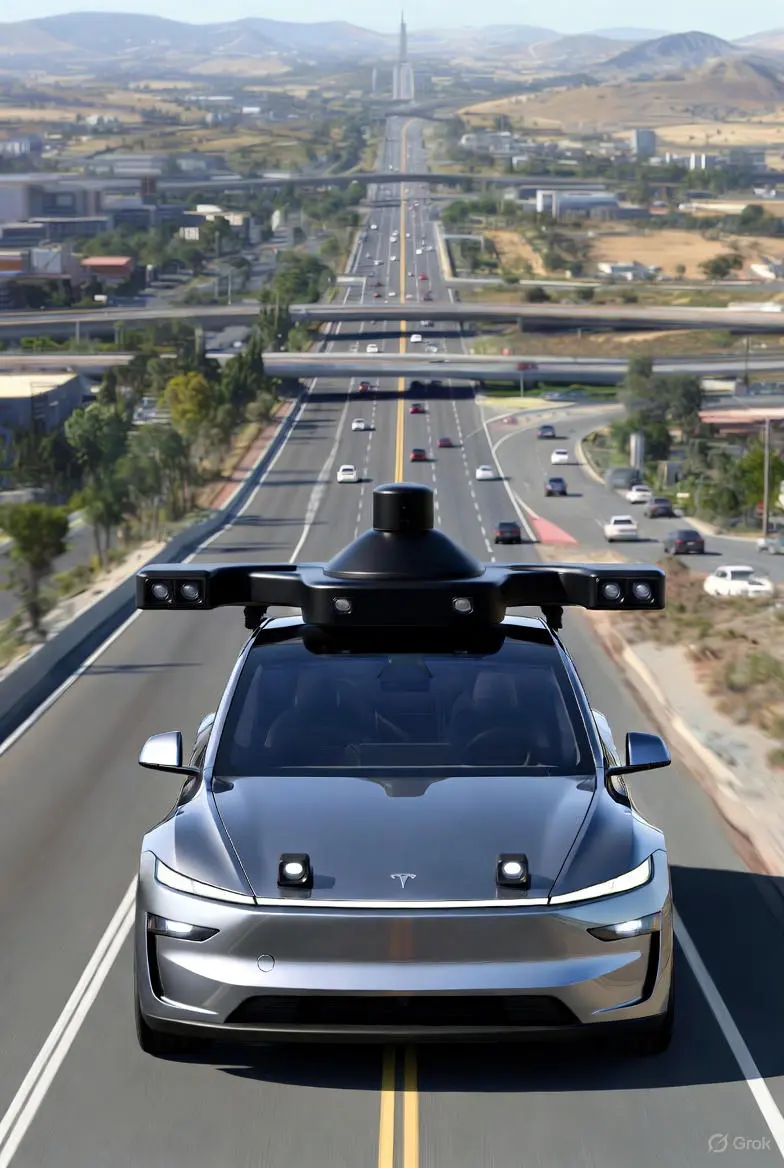
🔬 Analytical Perspective
This article explores hypothetical scenarios of how advanced AI systems could potentially approach autonomous navigation challenges. It examines current research trends and projects possible developments based on existing technologies. This is not breaking news about actual Tesla products but analysis of potential future directions in autonomous vehicle technology.
Beyond Traditional Navigation: How AI Could Redefine Autonomous Driving
As autonomous vehicle technology advances, researchers are exploring how future artificial intelligence systems might approach navigation challenges differently. While current systems rely on recognizing existing infrastructure, examining hypothetical approaches like “generative navigation” reveals what capabilities would be needed to handle complex, unstructured driving environments more effectively.
Autonomous navigation represents one of technology’s most complex challenges,
requiring real-time interpretation of dynamic environments. This analysis explores
how future systems could potentially move beyond perception-based approaches
toward more predictive, adaptive navigation methods. While current technology
focuses on identifying existing elements, examining more advanced possibilities
helps identify both opportunities and limitations in next-generation
autonomous driving systems.
Current Navigation Approaches & Emerging Research
Today’s autonomous vehicle systems primarily use sensor data to identify and react to their surroundings. Current approaches include:
📷 Computer Vision Systems
Cameras identify lanes, signs, vehicles, and pedestrians using pattern recognition algorithms trained on millions of driving images.
📡 Sensor Fusion
Combining radar, lidar, and ultrasonic sensors to create comprehensive environmental models with redundancy for safety.
🗺️ HD Mapping Integration
Using detailed pre-mapped environments to supplement real-time sensor data, particularly for complex urban areas.
These approaches have achieved significant progress but face challenges in unstructured environments, changing conditions, and “edge cases” that differ from training data. Research continues on making systems more robust and adaptable.
Generative Navigation Concepts: Research Possibilities
The concept of “generative navigation” involves systems that don’t just perceive environments but actively model possible pathways. Research areas exploring related ideas include:
- Predictive modeling: Systems that anticipate how traffic situations might evolve seconds ahead
- Path planning optimization: Algorithms that evaluate multiple possible routes simultaneously
- Simulation-based training: Using virtual environments to train systems on rare scenarios
- Adaptive behavior: Systems that adjust driving strategies based on environmental conditions
While no current system performs comprehensive “virtual road generation,” research continues on making autonomous navigation more predictive and adaptive rather than purely reactive.
Tesla’s Actual Autonomous Technology Development
Tesla’s current Full Self-Driving (FSD) technology represents one approach to autonomous navigation, though it operates within more conventional parameters than speculative “generative” systems:
| Current Capability | Actual Status | Research Directions |
|---|---|---|
| Highway navigation | Limited autonomous features | Expanding operational domains |
| Urban driving | Beta testing with human oversight | Improving complex scenario handling |
| Unstructured environments | Limited capability | Research focus area |
| Adverse conditions | Performance challenges | Improving robustness |
Technical Challenges in Advanced Autonomous Navigation
Key Technical Hurdles:
- Computational requirements: Real-time environment modeling demands significant processing power
- Sensor limitations: Current sensors have range, resolution, and condition constraints
- Prediction accuracy: Modeling complex human behavior and environmental changes remains challenging
- Safety verification: Ensuring system reliability across infinite possible scenarios
- Regulatory approval: Demonstrating safety for comprehensive autonomous operation
Human Perspectives
“As an autonomous systems researcher, I see the potential for more predictive navigation approaches that anticipate rather than just react. However, current technology remains focused on robust perception and safe reaction. The most promising near-term advances involve improving how systems handle complex, changing environments rather than fundamental paradigm shifts.” — Dr. Maria Chen, Autonomous Systems Researcher
“From a user perspective, current assisted driving features already help with highway navigation and traffic awareness. Future improvements that handle more complex urban environments would be valuable, though comprehensive autonomy in all conditions remains a significant technical challenge.” — James Rodriguez, Technology Analyst
These perspectives highlight the importance of incremental, evidence-based progress in autonomous technology rather than expecting sudden paradigm shifts.
Impact Analysis: A More Balanced View
- ⚡ Could potentially improve handling of unstructured and changing environments
- 🌍 Might enable broader operational capabilities in diverse conditions
- 💡 May represent evolutionary rather than revolutionary navigation approaches
- 📈 Could contribute to gradual expansion of autonomous vehicle capabilities
While potential benefits are significant, substantial challenges include computational requirements, sensor limitations, safety verification across infinite scenarios, and regulatory approval processes for increasingly capable systems.
Final Thoughts: Evolutionary Progress in Autonomous Technology
Rather than expecting sudden breakthroughs to comprehensive “generative navigation,” autonomous vehicle technology will likely advance through incremental improvements addressing specific challenges. Current research focuses on making systems more robust in complex environments, better at predicting other road users’ behavior, and more adaptable to changing conditions.
The value of examining advanced concepts lies in identifying research directions and capability goals. By understanding what would be required for more predictive, adaptive navigation, developers can focus current efforts on achievable improvements that gradually expand autonomous capabilities.
Ultimately, autonomous vehicle development represents a complex engineering challenge requiring advances across perception, prediction, planning, and control. Progress will likely come through sustained research addressing specific technical hurdles rather than singular paradigm shifts, gradually expanding where and how autonomous systems can operate safely and effectively.
🧠 AIROBOT Analysis
This analysis highlights the gap between current autonomous navigation capabilities and more advanced “generative” concepts. While current technology focuses on robust perception and safe reaction, research continues on making systems more predictive and adaptive. The most promising near-term advances involve incremental improvements rather than fundamental paradigm shifts.
From a technical perspective, significant challenges remain in computational requirements, sensor capabilities, prediction accuracy, and safety verification. These represent substantial research and engineering hurdles that will require sustained effort rather than sudden breakthroughs.
The most realistic path forward involves gradual expansion of autonomous capabilities through addressing specific technical challenges, with comprehensive “generative navigation” representing a long-term research goal rather than imminent development.
⏭ What Comes Next
Expect continued incremental improvements in autonomous vehicle capabilities: better handling of complex urban environments, improved performance in adverse conditions, and expanded operational domains. Research will focus on specific technical challenges rather than comprehensive paradigm shifts.
Practical deployment will emphasize systems that assist human drivers and operate in limited, well-defined conditions. Regulatory approval processes will likely require extensive validation for increasingly capable systems.
Long-term, autonomous technology may gradually expand to more challenging environments and conditions, though comprehensive navigation in all possible scenarios remains a distant goal requiring advances across multiple technical dimensions.
🔥 Breaking Insight — Analytical Summary
Headline:
Autonomous Navigation Evolution: From Perception to Prediction
Core Analysis:
Examining how future AI systems might approach navigation reveals both promising directions and significant technical challenges. While current technology focuses on perceiving and reacting to environments, research explores more predictive, adaptive approaches. However, comprehensive “generative navigation” represents a long-term goal rather than imminent development.
Why This Matters:
Understanding both possibilities and limitations helps identify realistic research priorities. The most promising path involves incremental improvements addressing specific autonomous navigation challenges rather than expecting sudden paradigm shifts to completely different approaches.
Key Realistic Developments:
- Improved perception in complex and changing environments
- Better prediction of other road users’ behavior
- Enhanced adaptability to diverse driving conditions
- Gradual expansion of operational capabilities
Expected Research Directions:
Continued focus on specific technical challenges: sensor performance, computational efficiency, prediction accuracy, and safety verification. Development of systems that handle increasingly complex environments through incremental improvements rather than fundamental redesign.
Final Perspective:
Autonomous vehicle technology will likely advance through sustained research addressing specific challenges rather than sudden breakthroughs to completely new paradigms. The most realistic path involves gradual expansion of capabilities through incremental improvements, with comprehensive navigation in all possible scenarios representing a long-term goal requiring advances across multiple technical dimensions.