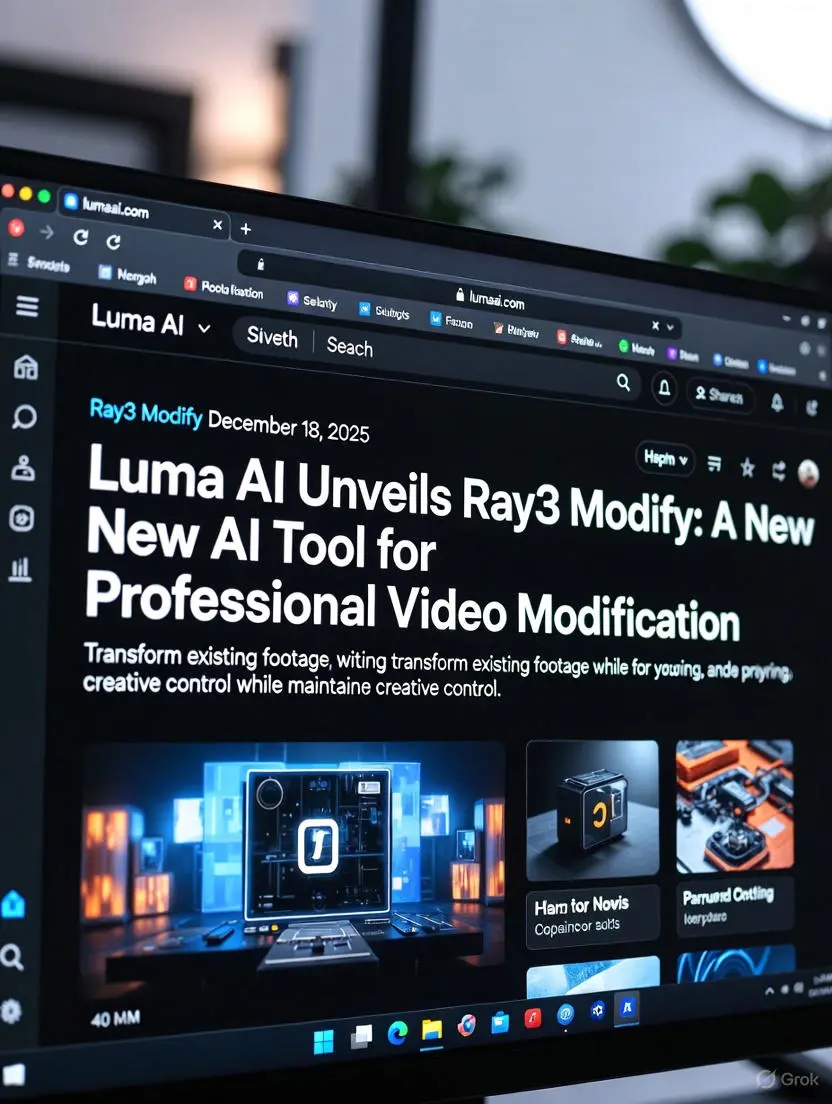
🔬 Analytical Perspective
This analysis examines Luma AI’s Ray3 Modify tool announced on December 18, 2025. It explores the professional video modification capabilities, technical approach, and potential implications for creative workflows based on available demonstration and company statements. This represents analysis of professional creative technology rather than promotional content.
Luma AI Ray3 Modify: Analyzing Professional Video Modification with AI Control
On December 18, 2025, Luma AI unveiled Ray3 Modify, a specialized AI tool designed for professional video modification that allows filmmakers to transform existing footage while maintaining creative control. Unlike general video generation tools, this system focuses on modifying real captured performances through AI-assisted transformations.
Official Demonstration and Interface
Luma AI’s announcement includes comprehensive demonstration of Ray3 Modify’s capabilities for professional video modification:
Official demonstration video from Luma AI showing Ray3 Modify’s professional video modification capabilities
Analysis of demonstrated workflow: The video shows professionals using reference images to transform actor appearances, modify locations, and control scene transitions while maintaining performance continuity. The interface appears designed for iterative refinement within existing production pipelines.
Ray3 Modify represents a specialized approach to AI video tools, focusing not on
generation from scratch but on controlled modification of existing footage.
The system allows creative teams to transform captured performances—changing
locations, costumes, or actor appearances—while maintaining the original
performance’s timing and emotion. This addresses specific professional
production challenges rather than pursuing general video synthesis, reflecting
maturing understanding of practical creative workflow needs.
Core Functionality: Professional Video Modification
Ray3 Modify introduces two primary capabilities for professional video production:
🎭 Character Transformation
Using reference images to modify actor appearances while preserving performance nuances like timing, emotion, and movement authenticity.
🏞️ Scene and Location Control
Transforming background environments while maintaining foreground performance consistency, potentially reducing physical set requirements.
🎬 Transition Direction
Using start and end reference frames to guide AI-generated transitions between scenes while maintaining narrative and visual continuity.
Professional Production Implications
Production Workflow Considerations:
- Cost Reduction Potential: Possible decreases in physical set construction, location shooting, and costume requirements
- Schedule Flexibility: Ability to modify scenes post-shoot without recalling actors or rebuilding sets
- Creative Experimentation: Safe exploration of alternative visual approaches without committing resources
- Consistency Challenges: Maintaining visual coherence across modified sequences in long-form content
- Skill Transition: Traditional crew adapting to AI-assisted workflows and new technical requirements
Industry Context and Market Position
Ray3 Modify enters a competitive landscape of AI tools targeting professional media production:
| Tool/Platform | Primary Focus | Professional Adoption |
|---|---|---|
| Luma AI Ray3 Modify | Modification of existing video footage | New release, targeting professional workflows |
| Runway ML Gen-2 | Text-to-video generation and editing | Established in indie/professional markets |
| Adobe After Effects AI | AI features within existing suite | Integration with professional pipelines |
| Wonder Dynamics | CG character integration into live action | Used in professional productions |
Executive Perspective and Company Vision
Strategic Direction from Leadership:
“Generative video models are incredibly expressive but also hard to control. Today, we are excited to introduce Ray3 Modify that blends the real-world with the expressivity of AI while giving full control to creatives. This means creative teams can capture performances with a camera and then immediately modify them to be in any location imaginable, change costumes, or even go back and reshoot the scene with AI, without recreating the physical shoot.”
— Amit Jain, co-founder and CEO of Luma AI
This statement emphasizes the tool’s focus on controlled modification rather than open-ended generation, addressing professional concerns about predictability and workflow integration.
Human Perspectives from Industry Professionals
“As a film producer, tools like Ray3 Modify could potentially reduce reshoot costs and location expenses. However, the true test will be whether it can maintain performance quality and emotional authenticity through transformations—actors’ subtle expressions matter as much as their appearance.” — Jonathan Reed, Film Producer
“From a VFX supervisor’s perspective, this represents another tool in the expanding AI-assisted production toolkit. The key will be integration with existing pipelines—can it output formats compatible with our color grading, compositing, and finishing workflows?” — Maria Chen, VFX Supervisor
“As an independent filmmaker with limited budget, controlled modification tools could democratize certain production values. But there’s learning curve consideration—will the time spent mastering AI tools offset the potential cost savings for smaller productions?” — Alex Rivera, Independent Director
Impact Analysis: Realistic Production Considerations
- 💰 Cost structure evolution with potential shifts from physical to digital production expenses
- ⏱️ Workflow adaptation as teams incorporate AI modification into existing processes
- 🎨 Creative expansion of visual possibilities within practical constraints
- 🔄 Skill requirement changes with growing importance of AI literacy in production roles
- 📊 Budget allocation adjustments as certain physical production costs potentially decrease
FAQ · Frequently Asked Questions for Professionals?
Luma AI Ray3 a limited free tier
Key Questions Professionals Ask
1. Is Luma AI Ray3 Modify a text-to-video generator?
No. Ray3 Modify focuses on modifying existing footage using reference-based control rather than generating video from text prompts.2. I Who is Ray3 Modify designed for?
It targets professional filmmakers, studios, VFX teams, and advanced independent creators working within structured production pipelines.3. I Can Ray3 Modify replace traditional VFX workflows?
No. It functions as an augmentation tool, complementing existing VFX, compositing, and finishing workflows rather than replacing them.4. I What types of projects benefit most from Ray3 Modify?
Projects requiring post-shoot flexibility, location or environment changes, costume variations, or controlled visual experimentation.5. Is trIs Ray3 Modify suitable for short-form or social media content?
Not primarily. The tool is optimized for professional, longer-form productions rather than rapid-turnaround social content.6. I What will determine professional adoption of Ray3 Modify?
Output consistency, integration with existing pipelines, learning curve, and cost-effectiveness compared to traditional methods.7. Is Luma AI Ray3 Modify free or paid, and are there limitations?
Yes — Luma AI offers a limited free tier where users can try out features (like draft-mode video generation with low resolution and restricted credits). To unlock full functionality, higher resolution outputs, more videos, no watermarks, priority processing, and commercial use rights, a paid subscription is required.
Final Thoughts: Professional-Grade AI Video Tools
Luma AI’s Ray3 Modify represents a significant evolution in AI video technology—moving from general generation tools toward specialized solutions addressing specific professional production challenges. By focusing on modification rather than creation, the tool acknowledges the irreplaceable value of captured human performance while offering new flexibility in its presentation.
The professional adoption timeline will depend on several factors: output quality consistency, workflow integration capabilities, cost-effectiveness relative to traditional methods, and the learning curve for creative teams. Early adopters will likely be productions with specific needs matching the tool’s strengths, such as projects requiring location flexibility or character appearance variations.
As the professional AI tool landscape continues to diversify, the most successful solutions will likely be those that understand existing production workflows deeply enough to complement rather than disrupt them. Ray3 Modify’s controlled approach suggests recognition of this principle, though its practical implementation remains to be tested in real production environments.
🧠 AIROBOT Analysis
Ray3 Modify’s strategic positioning as a modification tool rather than generation platform reflects maturing market understanding within the AI video sector. By targeting specific professional pain points—reshoot costs, location limitations, and post-production flexibility—Luma AI addresses tangible production challenges rather than offering generalized capabilities.
The tool’s success will depend heavily on output consistency and workflow integration. Professional productions cannot tolerate unpredictable results or disruptive workflow changes, regardless of theoretical capabilities. The demonstration suggests recognition of these requirements through controlled modification parameters and preservation of original performance elements.
From a market perspective, this specialized approach allows differentiation in a crowded field while potentially commanding premium pricing from professional users. However, it also narrows the addressable market compared to broader creative tools, creating different growth dynamics and adoption patterns.
⏭ What Comes Next
Following this December 2025 announcement, expect Luma AI to focus on professional pilot programs with production companies to refine workflows and demonstrate real-world value. Industry adoption will likely follow pattern-based learning from early implementations rather than immediate widespread deployment.
The coming months will reveal whether Ray3 Modify can achieve the quality consistency required for broadcast and theatrical standards or remains limited to specific use cases like pre-visualization, independent production, or content with forgiving quality requirements. Integration partnerships with existing professional software ecosystems will be particularly telling indicators of serious professional targeting.
For the broader industry, tools like Ray3 Modify contribute to ongoing conversations about AI’s role in creative fields—not as replacement for human creativity but as augmentation of technical possibilities. The most sustainable implementations will likely balance technological capability with respect for creative process and professional expertise.
🔥 Breaking Insight — Professional Production Analysis
Headline:
Controlled Modification over Generation: Luma AI’s Professional Video Strategy
Core Analysis:
Luma AI’s Ray3 Modify represents a strategic pivot toward professional production tools, focusing on controlled modification of existing footage rather than open-ended video generation. This approach addresses specific industry pain points—reshoot flexibility, location modification, and post-production control—while acknowledging the irreplaceable value of captured human performance.
Why This Matters:
The tool reflects maturing understanding of professional production realities, where predictability, workflow integration, and quality consistency outweigh raw creative potential. By targeting modification rather than generation, Luma AI positions itself as augmenting existing production methods rather than replacing them, potentially easing professional adoption concerns.
Key Professional Considerations:
- Workflow integration requirements with existing production pipelines
- Output consistency needed for professional quality standards
- Cost-benefit analysis of AI tools versus traditional methods
- Skill adaptation for crews transitioning to AI-assisted workflows
- Creative control preservation amid technological augmentation
Expected Professional Adoption Pattern:
Initial implementation in specific use cases matching tool strengths, followed by gradual expansion as workflows mature and confidence grows. Independent and innovative productions likely to pioneer adoption, with mainstream following contingent on demonstrated reliability and integration.
Final Perspective:
Ray3 Modify represents a sophisticated approach to professional AI video tools, balancing technological capability with practical production realities. Its success will depend less on impressive demos and more on consistent performance within real production environments, seamless workflow integration, and tangible value relative to established methods. The tool’s controlled modification focus suggests understanding of these professional imperatives, though real-world testing will determine its actual production impact.




One Comment
I get be free