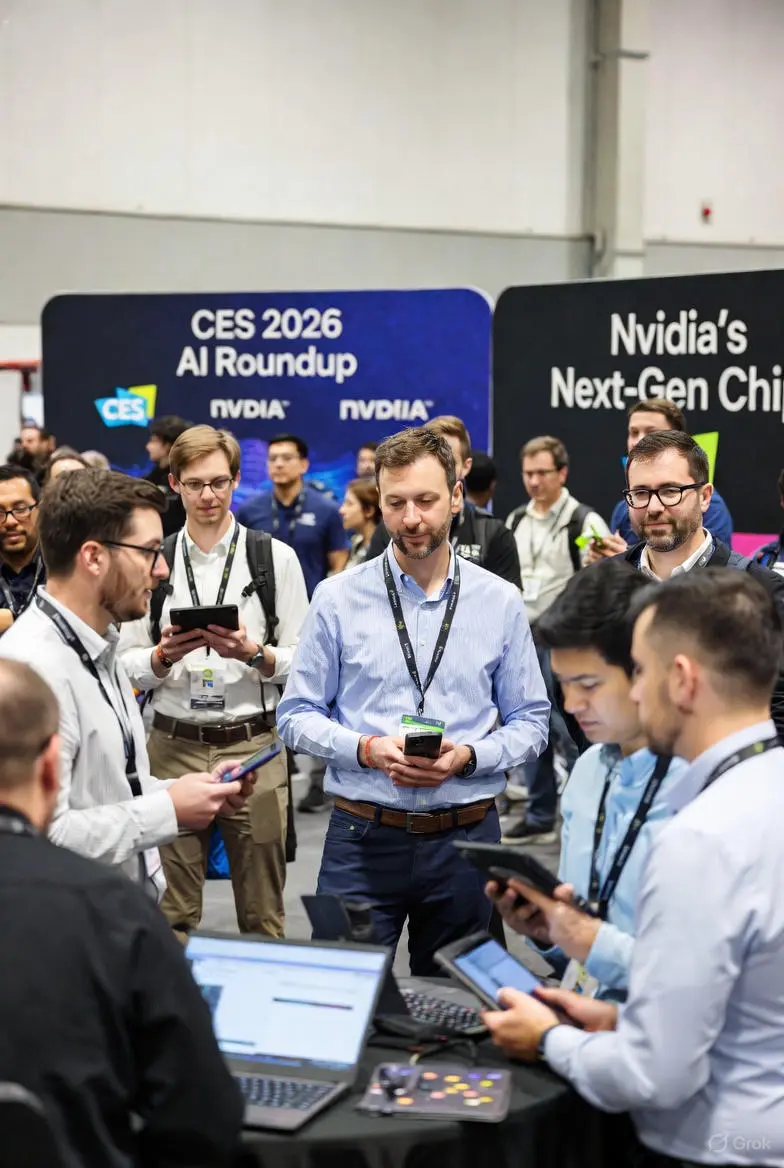
🔬 Realtime CES 2026 Analysis
This realtime analysis examines artificial intelligence announcements and product reveals from CES 2026, focusing on Nvidia’s new chip architectures, AMD’s competitive responses, and emerging AI gadget categories. Based on live reporting from the Consumer Electronics Show, this explores technical specifications, market implications, and innovation patterns as major technology companies showcase their 2026 AI hardware and device strategies. This represents immediate analysis of breaking AI technology developments based on same-event reporting.
CES 2026 AI Roundup: Nvidia’s Next-Gen Chips, AMD’s Counterplay, and the Emerging Ecosystem of AI Gadgets
January 8, 2026 – Live analysis from CES 2026 artificial intelligence announcements
The 2026 Consumer Electronics Show has erupted with significant artificial intelligence announcements, particularly in hardware and devices, as major technology companies reveal their strategic directions for the coming year. Nvidia’s next-generation AI accelerator announcements, AMD’s competitive chip responses, and a proliferation of AI-powered gadgets from companies like Razer and others demonstrate both the maturity of AI integration across consumer electronics and the intensifying competition in specialized AI hardware. CES 2026 reveals an industry transitioning from AI as software feature to AI as fundamental hardware capability across diverse product categories.
CES 2026 represents inflection point in AI hardware evolution—moving from
general-purpose acceleration toward specialized solutions for different
applications and form factors. Nvidia’s announcements target data center
leadership while expanding into new categories, AMD counters with efficiency-focused
alternatives, and consumer electronics companies integrate AI capabilities into
increasingly diverse and sometimes unusual devices. This analysis examines
how 2026’s CES reveals both AI technology maturation and market fragmentation
as different players pursue distinct strategic paths.
Major AI Hardware Announcements
Key reveals from semiconductor and device companies:
⚡ Nvidia’s Next Generation
New AI accelerator architecture announcements targeting both data center efficiency improvements and expansion into automotive, edge computing, and specialized inference applications, building on Blackwell foundation with architectural refinements for specific workloads.
🔄 AMD’s Strategic Response
Competitive chip announcements emphasizing power efficiency, cost-effectiveness, and specific optimizations for inference workloads and edge deployment scenarios, challenging Nvidia’s dominance in selected market segments.
🎮 Razer’s AI Integration
Gaming and peripheral devices incorporating specialized AI processors for real-time performance optimization, personalized settings adaptation, and enhanced user experience through on-device machine learning rather than cloud dependence.
CES 2026 AI Product Categories and Trends
Emerging AI Device Patterns at CES 2026:
- AI-Enhanced Gaming Hardware: Graphics cards, peripherals, and systems with dedicated AI processors for real-time optimization and personalization
- Smart Home Evolution: Traditional smart home devices gaining sophisticated on-device AI capabilities for privacy-preserving local processing
- Wearable AI Expansion: Beyond smartwatches to specialized wearables with AI-powered health monitoring, productivity enhancement, and context awareness
- Automotive AI Integration: In-vehicle AI systems for enhanced safety, entertainment, and autonomous features beyond current ADAS implementations
- AI-Powered Content Creation Tools: Cameras, audio equipment, and editing devices with integrated AI for real-time enhancement and automation
Technical Specifications and Competitive Positioning
Different approaches to AI hardware implementation at CES 2026:
| Company/Category | AI Approach | CES 2026 Focus |
|---|---|---|
| Nvidia | Architectural refinement and expansion | Next-gen data center AI, automotive, edge inference |
| AMD | Efficiency and specialization | Power-efficient inference, edge optimization |
| Consumer Electronics | Application-specific integration | On-device AI for enhanced functionality |
| Startup Innovations | Niche optimization and new form factors | Specialized AI devices, unusual applications |
Market Implications and Competitive Dynamics
CES 2026 reveals evolving competitive landscape in AI hardware:
Key Competitive Developments:
- Specialization Acceleration: Different chips optimized for specific AI workloads rather than general-purpose acceleration
- Edge AI Maturation: On-device AI capabilities reaching parity with cloud-offloaded approaches for many applications
- Power Efficiency Focus: Performance-per-watt becoming primary competitive metric alongside raw compute capability
- Ecosystem Expansion: AI hardware moving beyond data centers to diverse consumer and industrial applications
- Integration Depth Increase: AI capabilities becoming fundamental architectural elements rather than add-on features
Industry and Analyst CES Perspectives
“CES 2026 demonstrates AI’s transition from software novelty to hardware fundamental. What we’re seeing isn’t just devices with AI features but devices whose architectures are fundamentally shaped by AI requirements—different memory hierarchies, specialized compute elements, and power management approaches optimized for machine learning workloads.” — Morgan Little, CES 2026 reporting
“From competitive perspective, CES reveals both consolidation and fragmentation in AI hardware. Nvidia continues expanding its architecture across domains, but we’re also seeing specialized competitors like AMD targeting efficiency-sensitive segments and consumer electronics companies developing application-specific AI implementations that don’t rely on general-purpose AI chips.” — Industry analyst commenting on CES trends
“The most interesting developments might be in what some are calling ‘AI oddities’—unusual devices that wouldn’t exist without affordable, efficient AI processors. These represent not just technological capability but exploration of new human-AI interaction paradigms that could eventually become mainstream.” — CES attendee observation on emerging device categories
Technical Innovation and Implementation Challenges
- ⚡ Thermal Management: Dissipating heat from increasingly powerful AI processors in consumer device form factors
- 🔋 Power Budget Constraints: Delivering meaningful AI capabilities within battery-operated device power envelopes
- 🛠️ Development Tool Maturity: Software frameworks and tools for diverse AI hardware architectures reaching production readiness
- 🔌 Interoperability Standards: Ensuring AI capabilities work consistently across different hardware platforms and ecosystems
- 📊 Performance Benchmarking: Developing meaningful metrics for comparing AI performance across diverse applications and form factors
Forward Analysis: Post-CES 2026 Trajectories
CES 2026 announcements suggest several developments through 2026. Product availability following CES reveals will test market reception and technical implementation. Competitive responses to announced products will shape pricing, feature sets, and ecosystem development. Emerging device categories may gain traction or fade based on user adoption and practical utility.
The broader implication involves AI becoming increasingly embedded in hardware rather than layered on software. This embedded approach may enable new applications, improve efficiency, and create more seamless user experiences while potentially creating new competitive dynamics where hardware capabilities constrain or enable AI functionality.
🧠 AIROBOT Analysis
CES 2026 represents significant milestone in AI hardware evolution—the transition from AI as computational capability to AI as architectural principle. Announcements across semiconductor companies, consumer electronics manufacturers, and specialized device makers demonstrate integration of AI considerations into fundamental product design rather than addition of AI features to existing architectures.
From technical perspective, the most significant trend may be diversification of AI implementation approaches. Rather than converging on single optimal architecture, the industry appears to be developing specialized solutions for different applications—data center training, edge inference, consumer device enhancement, automotive systems, etc. This specialization reflects AI’s maturation from general capability to domain-specific toolset.
The competitive dynamics revealed at CES suggest both consolidation in certain segments (Nvidia’s continued data center strength) and fragmentation in others (diverse approaches to edge and consumer AI). This pattern may characterize 2026’s AI hardware landscape: established leaders extending dominance in core markets while new entrants and approaches emerge in evolving applications.
⏭ What Comes Next
Following CES 2026 announcements, expect several developments throughout 2026: product launches and availability of announced technologies, competitive responses and counter-announcements, user adoption patterns for new AI device categories, technical refinement based on initial implementation feedback, and potential emergence of additional AI hardware innovations not showcased at CES.
Key areas to watch include actual performance versus claimed specifications, power efficiency in real-world usage, software ecosystem development around new hardware, market reception of unusual AI device concepts, and potential regulatory attention to AI-enabled consumer products as they become more widespread.
The ultimate impact of CES 2026’s AI announcements will become clearer through 2026 as products reach market, users adopt new capabilities, and competitive responses unfold. The show establishes strategic directions that will shape AI hardware development and deployment throughout the year.
🔥 Breaking Insight — CES 2026 Trend Analysis
Headline:
Hardware-AI Convergence: How CES 2026 Reveals Artificial Intelligence Becoming Architectural Foundation Rather Than Added Feature
Core Analysis:
CES 2026 demonstrates fundamental shift in artificial intelligence implementation—moving from software capability running on general-purpose hardware to architectural principle shaping hardware design from inception. This convergence manifests across semiconductor announcements (chips designed specifically for AI workloads), consumer electronics reveals (devices whose form factors and capabilities depend on integrated AI), and emerging product categories (applications enabled only by efficient, specialized AI processing). The show reveals industry transitioning from adding AI to existing products to designing products around AI capabilities.
Why This Architectural Shift Matters:
When AI influences hardware architecture rather than merely utilizing it, different design priorities emerge: memory hierarchies optimized for model weights rather than general data, power management focused on bursty inference patterns rather than continuous computation, thermal solutions for sporadic high-intensity processing rather than sustained loads. These architectural choices enable capabilities impossible with software-only AI approaches—real-time personalization without cloud dependence, privacy-preserving local processing, and always-available intelligence within power-constrained devices.
CES 2026 Architectural Indicators:
- Specialized compute elements: Dedicated AI processors rather than general-purpose cores with AI acceleration
- Memory architecture optimization: Hierarchies designed for model weight access patterns
- Power management innovation: Systems that activate AI capabilities only when needed
- Form factor enablement: Device designs that depend on efficient local AI processing
- Application specialization: Hardware optimized for specific AI workloads rather than general acceleration
2026 Post-CES Trajectory:
Rapid implementation of CES-announced architectures in shipping products, competitive responses driving further specialization, emergence of new device categories enabled by efficient local AI, increasing differentiation between cloud-dependent and locally-intelligent devices, and potential standardization efforts around successful architectural approaches. The architectural innovations showcased at CES 2026 will likely influence product development throughout the year and beyond.
Final CES Perspective:
CES 2026 may be remembered as moment when artificial intelligence transitioned from software revolution to hardware evolution. The announcements and reveals demonstrate AI becoming integral to product architecture rather than additional feature—shaping everything from semiconductor design to consumer device form factors to application possibilities. This architectural integration enables new capabilities and experiences while creating different competitive dynamics where hardware-AI co-design becomes advantage. As products based on these architectural approaches reach market through 2026, they may establish patterns that influence AI implementation for years, potentially making locally intelligent, efficiently operating AI-enabled devices standard rather than exception across consumer electronics, computing, and beyond.
Tags: artificial-intelligence, tech-analysis, innovation, hardware
Realtime analysis published January 8, 2026, based on CES 2026 announcements and reveals regarding artificial intelligence hardware, chips, and devices. This analysis focuses on immediate implications and emerging trends from the Consumer Electronics Show.